Introduction
Artificial Intelligence (AI) is no longer a futuristic concept—it has become a powerful engine driving the evolution of AI in marketing. As brands across the globe adopt intelligent technologies, AI is reshaping how marketers understand consumers, automate complex workflows, and deliver measurable business results. As Andrew Ng, co-founder of Coursera, famously stated, “AI is the new electricity,” highlighting how AI in marketing is having a transformational impact similar to past industrial revolutions.
Today, AI in marketing enables businesses to analyze massive volumes of customer data, predict behavior with precision, and optimize campaigns in real time. From hyper-personalized messaging to automated decision-making, marketers can now create customer experiences that were unimaginable just a few years ago. As consumer expectations continue to rise and digital competition intensifies, organizations that fail to adopt AI in marketing risk losing relevance, efficiency, and market share. The shift from manual processes to AI-driven marketing strategies is no longer optional—it is a strategic necessity.
In this blog, we explore the true purpose of AI in marketing through real-world insights and practical examples. We highlight 20 powerful real-life use cases that show how AI in marketing is influencing customer engagement, campaign execution, and business outcomes. Along with the opportunities AI offers, this article also discusses the key benefits as well as the potential limitations and challenges of using AI in marketing. By the end, you will have a clear, unbiased understanding of what AI in marketing can do and how it impacts modern marketing practices today.
“AI doesn’t eliminate creativity in marketing—it amplifies it with intelligence and precision.” — Industry Expert
“AI is transforming marketing from a creative guessing game into a data-driven growth engine.” — Marketing Industry Insight
Market Statistics: AI in Marketing Adoption & Impact
The pace of AI adoption in marketing continues to accelerate year after year. According to recent research, the global AI in marketing market has exploded in growth — reaching an estimated $47.32 billion in 2025, and projected to surpass $107.5 billion by 2028 with a compound annual growth rate (CAGR) of about 36.6%.
Source: https://salesgroup.ai/ai-marketing-statistics/
These figures highlight more than just investment dollars — they reflect how deeply AI tools have penetrated everyday marketing workflows. A staggering 88% of marketers now use AI in their daily tasks, achieving up to 300% average ROI while cutting customer acquisition costs by nearly 37%.
Source: https://salesgroup.ai/ai-marketing-statistics/
Generative AI — tools that can produce text, images, and other creative assets — has also become mainstream. Roughly 73% of marketing teams leverage generative AI for content creation, ideation, editing, and creative production.
Source: https://sopro.io/resources/blog/ai-sales-and-marketing-statistics/
Moreover, reports suggest that 80% of marketers believe AI will revolutionize the industry by 2025, with significant improvements to personalization, segmentation, and campaign performance.
Source: https://www.mailmodo.com/guides/ai-marketing-statistics/
From personalization to automation, AI isn’t just being tested — it’s being embedded into the daily fabric of marketing operations.
The Purpose of AI in Marketing
At its core, the purpose of AI in marketing is to augment human ability with computational power — enabling deeper customer understanding, faster decision-making, and more impactful engagement:
- Customer Insights & Personalization: AI analyzes massive datasets to uncover patterns, segment audiences, and tailor content based on individual preferences.
- Automation of Routine Tasks: Repetitive tasks like scheduling posts, generating reports, and optimizing bids are automated, freeing up marketers to focus on strategy.
- Enhanced Performance & Optimization: Real-time data monitoring and machine learning models optimize campaigns instantly — improving conversion rates and ROI.
- Predictive Intelligence: AI models anticipate customer behavior, forecast trends, and identify opportunities before competitors do.
- Competitive Differentiation: Brands that adopt AI effectively can deliver richer experiences faster, leading to higher retention and growth.
In short, AI helps marketers work smarter, not harder — blending creativity with computation to deliver measurable business results.
AI in Marketing: Transforming Business Strategies
Below are 20 powerful ways AI is being used across industries, showing its impact:
1. Predictive Analytics for Customer Behaviour
AI models analyze historical data to forecast future actions — such as predicting churn or identifying high-value leads. A major telco company used predictive models to reduce churn and tailor retention campaigns with significantly higher success rates.
2. Intelligent Chatbots and Conversational AI
Modern AI chatbots powered by natural language processing (NLP) provide 24/7 customer support and help capture leads — reducing support tickets and increasing engagement.
3. Automated Content Generation
Marketers use generative AI to produce blogs, social posts, and ad copy — saving up to 80% of content production time while maintaining quality and SEO relevance.
4. Personalized Email Marketing
AI analyzes user behavior to send hyper-personalized email campaigns with optimized send times, subject lines, and offers — leading to higher open and click-through rates.
5. Dynamic Pricing Optimization
AI adjusts prices in real-time based on demand, inventory, and competitor pricing — helping retailers maximize revenue margins.
6. Customer Segmentation
AI segments audiences using behavior and intent signals — enabling marketers to tailor messaging for each group.
7. Programmatic Advertising
AI automates media buying, placing ads in front of the right audience at the right time — improving ad spend efficiency and reducing waste.
8. Visual and Creative Generation
AI tools like Midjourney and DALL-E generate visuals for campaigns — saving time and reducing cost. A fintech brand saved millions annually by using AI for graphic production.
9. Voice Search Optimization
AI helps marketers optimize content for voice search queries — increasing visibility in voice-enabled devices.
10. Social Listening & Trend Analysis
AI tools analyze billions of social conversations to surface trends and consumer sentiment, enabling agile campaign responses.
11. SEO and Keyword Insights
AI evaluates search trends and competitive content to advise on SEO strategy, boosting organic rankings.
12. Lead Scoring
Machine learning models assign scores to prospects based on likelihood to convert — improving sales and marketing alignment.
13. Customer Lifetime Value Prediction
AI estimates customer lifetime value to prioritize marketing investment on high-potential segments.
14. Real-Time Campaign Optimization
AI continuously tunes campaigns based on performance data — reducing costs while raising conversion rates.
15. A/B Testing Automation
AI automates multivariate testing — identifying the best performing creative or message instantly.
16. Recommendation Engines
E-commerce sites use AI to suggest products based on browsing and purchase history, increasing average order value.
17. Sentiment Analysis
AI analyzes reviews, comments, and feedback to understand customer feelings — shaping product positioning and messaging.
18. Influencer Marketing Analytics
AI evaluates influencer performance data and audience quality — helping brands choose impactful partnerships.
19. Video Content Personalization
AI edits and tailors video content to different audience segments, improving engagement metrics.
20. Real-Time Personalization on Websites
AI delivers custom website content based on visitor profiles — boosting engagement and conversions.
20 Real-World Use Cases of AI in Marketing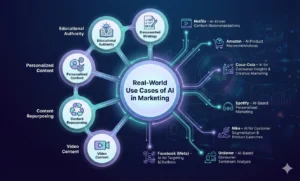
1. Netflix – AI-Driven Content Recommendations
Netflix uses AI algorithms to analyze user viewing behavior, watch time, and preferences to recommend personalized content.
Impact: Over 80% of content watched on Netflix comes from AI-powered recommendations, significantly reducing churn and increasing engagement.
2. Amazon – AI Product Recommendations
Amazon uses AI to suggest products based on browsing history, purchase behavior, and similar customer patterns.
Impact: AI recommendations contribute to nearly 35% of Amazon’s total revenue by improving cross-selling and upselling.
3. Coca-Cola – AI for Consumer Insights & Creative Marketing
Coca-Cola uses AI to analyze social media data, customer feedback, and market trends to guide campaign decisions and product launches.
Impact: Improved campaign relevance and faster go-to-market strategies.
4. Starbucks – AI-Powered Personalized Offers
Starbucks uses its AI engine Deep Brew to personalize offers, promotions, and app notifications.
Impact: Increased customer retention and higher mobile app engagement.
5. Sephora – AI Chatbots & Virtual Assistants
Sephora’s AI chatbot and virtual assistant help customers choose products based on preferences and skin type.
Impact: Higher conversion rates and enhanced in-store and online experiences.
6. Spotify – AI-Based Personalized Marketing
Spotify uses AI to create personalized playlists like Discover Weekly and Wrapped campaigns.
Impact: Massive user engagement and viral marketing with minimal ad spend.
7. Airbnb – AI-Driven Pricing & Content Optimization
Airbnb uses AI to dynamically optimize listing prices and personalize search results.
Impact: Increased booking rates and improved host earnings.
8. HubSpot – AI Content & Lead Scoring
HubSpot uses AI to score leads, recommend content topics, and personalize email marketing.
Impact: Higher lead-to-customer conversion rates for businesses using HubSpot tools.
9. Nike – AI for Customer Segmentation & Product Launches
Nike uses AI to analyze consumer behavior across apps and platforms to personalize product launches and messaging.
Impact: Stronger brand loyalty and improved digital sales growth.
10. Unilever – AI-Based Consumer Sentiment Analysis
Unilever analyzes millions of online conversations using AI to understand sentiment and trends.
Impact: Faster campaign decisions and better brand positioning.
11. L’Oréal – AI Virtual Try-On Technology
L’Oréal uses AI-powered AR tools to allow customers to virtually try makeup products.
Impact: Increased online engagement and reduced product return rates.
12. Google Ads – AI-Powered Smart Bidding
Google Ads uses machine learning to automatically optimize bids based on conversion likelihood.
Impact: Advertisers achieve better ROI and improved campaign performance.
13. Facebook (Meta) – AI Ad Targeting
Meta uses AI to analyze user behavior and serve hyper-targeted ads.
Impact: Improved ad relevance and higher advertiser ROI.
14. Salesforce – AI Marketing Automation (Einstein AI)
Salesforce Einstein AI predicts customer behavior and automates personalized marketing journeys.
Impact: Enhanced customer engagement and sales alignment.
15. Domino’s – AI Voice Ordering & Chatbots
Domino’s uses AI-powered chatbots and voice assistants to simplify ordering.
Impact: Faster ordering experience and higher repeat purchases.
16. Alibaba – AI Personalization at Scale
Alibaba uses AI to personalize product recommendations during major events like Singles’ Day.
Impact: Billions in sales driven by AI-led personalization.
17. Heinz – AI-Generated Creative Campaigns
Heinz used AI image-generation tools to create visuals for a creative marketing campaign.
Impact: Massive PR coverage and brand engagement due to AI-driven creativity.
18. Booking.com – AI-Based A/B Testing
Booking.com runs thousands of AI-driven A/B tests to optimize website content and user experience.
Impact: Continuous conversion rate optimization and revenue growth.
19. IKEA – AI Chatbots & Product Recommendations
IKEA uses AI chatbots to help customers find products and plan purchases.
Impact: Reduced customer service costs and improved buyer experience.
20. Procter & Gamble – AI Demand Forecasting & Marketing Optimization
P&G uses AI to forecast demand and align marketing campaigns accordingly.
Impact: Reduced waste, optimized inventory, and higher marketing efficiency.
Pros and Cons of AI in Marketing
| Pros | Cons |
| Enhanced personalization at scale | Data privacy & compliance concerns |
| Improved campaign performance & ROI | High initial implementation cost |
| Automates repetitive tasks | Skill gaps and learning curve |
| Predictive insights for strategic decisions | Risk of over-reliance on automation |
| Faster content production | Quality may vary without human oversight |
| Better customer experience and engagement | Ethical concerns (bias, transparency) |
Benefits of AI in Marketing
AI delivers business value across multiple dimensions:
- Efficiency & Productivity: By automating repetitive tasks, AI allows teams to focus on strategic initiatives — driving up productivity and output.
- Improved ROI: Marketers who use AI report significantly higher returns compared to traditional methods — thanks to better targeting, personalization, and campaign optimization.
- Scalability: AI enables 1:1 personalization at scale, something that would be impossible to achieve manually.
- Real-Time Decision Making: AI processes vast datasets instantly — enabling marketers to react to performance signals in real time.
- Enhanced Customer Experiences: From tailored recommendations to 24/7 support through chatbots, AI elevates the quality of customer interactions.
Conclusion
AI is redefining the rules of marketing. From automating mundane tasks to driving strategic insights, the impact of AI is felt across every stage of the customer journey. Marketing teams that embrace AI — not as a novelty, but as a strategic partner — unlock higher efficiency, stronger customer engagement, and superior business outcomes.
As adoption accelerates, marketers must continue to innovate responsibly, balancing automation with human creativity and ethical considerations. AI isn’t replacing marketers — it’s empowering them to do more with less and deliver value at unprecedented speed and scale.
Why Choose Next Tech Marketer
In an era where AI in Marketing is rapidly evolving, choosing the right learning and implementation partner is critical. Next Tech Marketer stands out as a future-focused digital marketing education and consulting platform that bridges the gap between theory, tools, and real-world application.
What sets Next Tech Marketer apart is its industry-aligned curriculum designed to match current and upcoming marketing trends, especially AI-driven strategies. Instead of generic concepts, learners gain hands-on exposure to real AI marketing tools, live projects, and case studies that reflect actual business challenges.
Next Tech Marketer emphasizes:
- Practical, job-ready skills rather than just certifications
- AI-powered marketing techniques, including automation, analytics, personalization, and content generation
- Expert-led training from professionals actively working in digital and AI-driven marketing
- Business-oriented learning, making it ideal for entrepreneurs, working professionals, and marketing teams
Additionally, the platform focuses on ethical AI usage, data privacy awareness, and performance measurement — ensuring learners not only use AI tools effectively but also responsibly. Whether you are a beginner exploring AI in marketing or a professional looking to upskill, Next Tech Marketer provides a structured, reliable, and future-proof learning path.
By choosing Next Tech Marketer, businesses and individuals gain more than education — they gain a strategic advantage in the AI-driven marketing landscape.
5 FAQs: AI in Marketing
- What is AI in marketing?
AI in marketing refers to the application of intelligent algorithms and machine learning to automate tasks, derive insights, and optimize campaigns for better business results. - How can small businesses use AI?
Small businesses can leverage AI for social media scheduling, email personalization, customer segmentation, chatbot support, and affordable content generation tools. - Are there risks to using AI tools in marketing?
Yes. Key risks include data privacy concerns, biased outputs, ethical considerations, and the potential for over-automating without strategic oversight. - How do I choose the right AI marketing tool?
Start with your business goals — such as content creation, analytics, or automation — and evaluate tools based on use case fit, ease of integration, pricing, and support. - What skills do marketers need for AI?
Essential skills include data literacy, understanding AI ethics, proficiency with AI tools and dashboards, and the ability to interpret insights for strategic decisions.