Introduction: The SEO Landscape in 2026 – Strategic, AI-Driven, and Evolving
Search Engine Optimization (SEO) isn’t what it used to be — and honestly, it hasn’t been for the last 12 months. In 2025 and into 2026, SEO has undergone one of the most profound shifts since the dawn of mobile indexing — driven largely by artificial intelligence. According to recent industry data, AI-powered summaries — called AI Overviews — now appear in up to 47% of Google search queries, reshaping how searchers consume content and how professionals must now approach SEO Interview Questions with a more strategic mindset.
“SEO in 2026 is not just about rankings — it’s about visibility in AI responses, intent alignment, and delivering user value at every step.”
This evolution has changed the way candidates should prepare for SEO Interview Questions. Employers no longer want textbook definitions alone — they want professionals who understand how AI impacts search visibility, user behaviour and content performance. Imagine walking into an interview where you’re expected not just to define canonical SEO concepts like crawling or indexing, but to explain how you would strategically improve organic visibility in an AI-dominated search environment. Modern SEO Interview Questions are designed to test your ability to think beyond keywords and demonstrate real-world problem-solving.
Organic search still drives the majority of web traffic — over 53.3% of website visits — but user behavior is fragmenting as AI interfaces and zero-click environments grow. This shift means today’s SEO Interview Questions often focus on strategy, data interpretation, and optimization for AI-driven SERPs.
Even seasoned SEOs agree:
In 2026, SEO professionals must think more like digital strategists than keyword rank chasers.
That’s why preparing for SEO Interview Questions now requires practical strategy, hands-on tool knowledge, and an understanding of how search engines are evolving — not just memorization of definitions.
In this blog, we’ll walk you through the Top 20 SEO Interview Questions and Answers for 2026, complete with expert insights, pro tips, and guidance on how to answer like a true SEO strategist.
Why SEO Skills Are in High Demand And Why They Matter
Before diving into interview Q&A, let’s contextualize why SEO expertise remains a career force in 2026.
Growing Career Opportunities in SEO
SEO isn’t a “nice to have” anymore — it’s central to digital growth. Businesses still rely on organic search as their most cost-efficient acquisition channel. Organic search consistently outperforms paid search and social in long-term ROI.
Source: https://www.smamarketing.net/blog/80-seo-statistics
Salary Trends and Career Growth
SEO professionals are well-compensated:
| Role | Median Salary (Avg) |
| SEO Specialist | $51,680+ |
| Senior SEO Specialist | $60,000+ |
| SEO Manager/Head | $75,000+ |
| Freelancers | $58,000+ |
(Global Average) https://dndseoservices.com/blog/seo-statistics-benchmarks-2026/
AI literacy and strategy skills can command even higher pay — especially roles focused on AI optimization, analytics, and technical SEO.
Benefits of Learning SEO
Career Opportunities
SEO skills are in high demand across digital marketing roles like SEO Specialist, Digital Marketing Executive, Content Strategist, and Growth Marketer.
Freelancing & Remote Work
SEO allows you to work independently as a freelancer or consultant, offering services like website audits, keyword research, and ranking improvement.
High ROI Skill
Businesses rely on SEO for long-term organic traffic, making it a valuable skill that directly contributes to revenue growth.
Data-Driven Thinking
Learning SEO improves your ability to analyze data, understand user behavior, and make strategic marketing decisions.
Long-Term Digital Asset Building
SEO helps build content and websites that generate traffic and leads consistently over time.
Top 20 SEO Interview Question and Answer
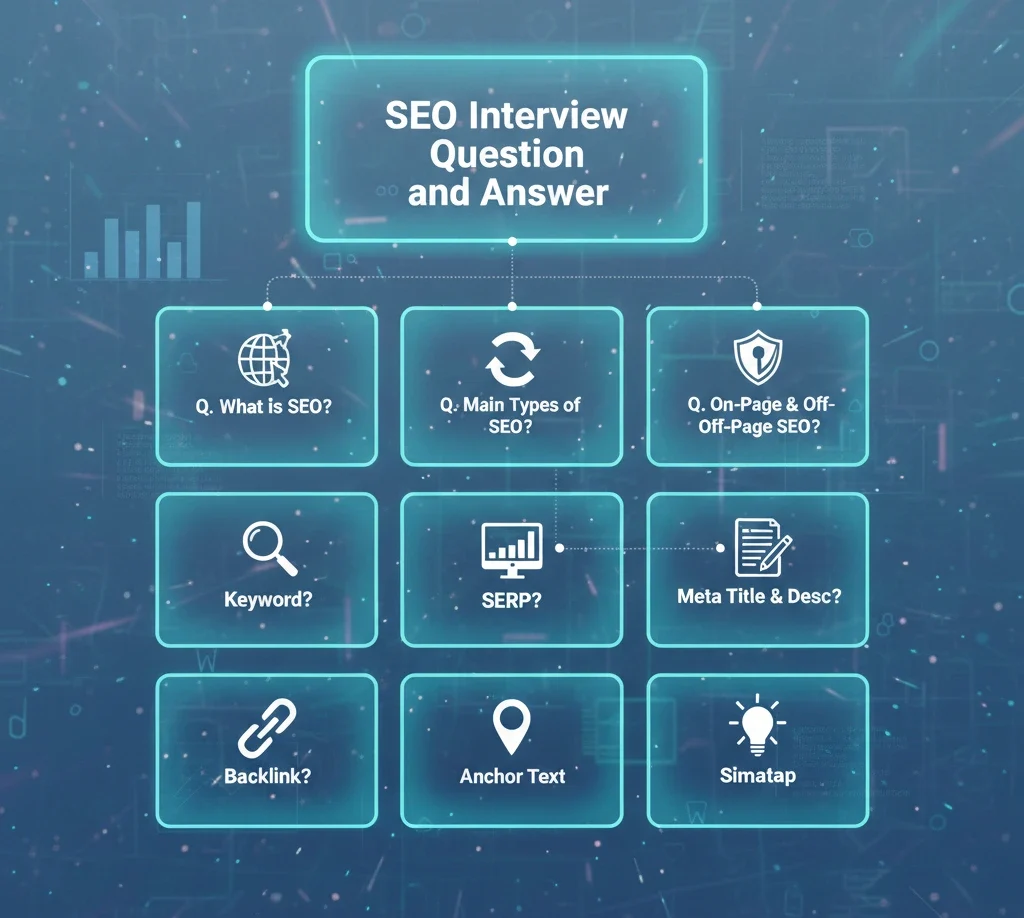
1. What is SEO?
Answer:
SEO (Search Engine Optimization) is the process of improving a website’s visibility in search engine results to drive organic (non-paid) traffic. It involves optimizing content, technical structure, and authority signals so search engines can understand, rank, and present pages to users.
SEO today goes beyond keywords — it focuses on user intent, experience, and value.
Pro Tip:
Say that SEO is about solving user problems, not just ranking pages. Interviewers love a user-first mindset.
2. What are the Main Types of SEO?
Answer:
There are three primary types:
- On-Page SEO – Content, keywords, headings, internal links
- Off-Page SEO – Backlinks, brand mentions, authority
- Technical SEO – Site speed, crawlability, indexing, structured data
All three must work together for strong rankings.
Pro Tip:
Mention that technical SEO is the foundation — without it, great content may never rank.
3. What is the Difference Between On-Page and Off-Page SEO?
Answer:
On-page SEO focuses on elements within your website (content quality, keywords, structure).
Off-page SEO focuses on external signals like backlinks and online reputation.
On-page builds relevance; off-page builds trust and authority.
Pro Tip:
Use this phrase: “On-page tells Google what the page is about, off-page tells Google how trustworthy it is.”
4. What is a Keyword?
Answer:
A keyword is a word or phrase users type into search engines. SEO involves identifying and targeting keywords that match user intent and business goals.
Keywords now fall into intent categories: informational, navigational, transactional, and commercial.
Pro Tip:
Always mention search intent — modern SEO is intent-driven, not just volume-driven.
5. What is Keyword Research?
Answer:
Keyword research is the process of discovering search terms your audience uses. It involves analyzing:
- Search volume
- Competition
- User intent
- Trends
The goal is to target keywords that bring qualified traffic.
Pro Tip:
Say you group keywords into topic clusters instead of targeting single keywords in isolation.
6. What is a SERP?
Answer:
SERP stands for Search Engine Results Page. It includes organic listings, ads, featured snippets, local packs, images, videos, and AI-generated summaries.
Modern SEO also aims to appear in rich results, not just blue links.
Pro Tip:
Mention SERP features — interviewers want candidates who understand visibility beyond rankings.
7. What is a Meta Title and Meta Description?
Answer:
- Meta Title is the clickable headline in search results
- Meta Description is the summary below it
They influence click-through rate (CTR) but are not direct ranking factors.
Pro Tip:
Optimizing for CTR improvement is a smart performance strategy.
8. What is a Backlink?
Answer:
A backlink is a link from another website pointing to your site. It signals authority and trust to search engines.
High-quality, relevant backlinks improve domain credibility.
Pro Tip:
Quality > quantity. One strong editorial link beats 100 spammy links.
9. What is Anchor Text?
Answer:
Anchor text is the clickable text in a hyperlink. It helps search engines understand the context of the linked page.
Types include exact match, branded, generic, and partial match.
Pro Tip:
Avoid over-optimized anchor text — keep it natural.
10. What is Technical SEO?
Answer:
Technical SEO ensures search engines can crawl, render, and index your site efficiently. It includes:
- Site speed
- Mobile friendliness
- XML sitemaps
- Robots.txt
- Canonical tags
Pro Tip:
Say: “Technical SEO removes barriers between search engines and content.”
11. What is Crawling, Indexing, and Ranking?
Answer:
- Crawling – Search engines discover pages
- Indexing – Pages are stored in the database
- Ranking – Pages are ordered based on relevance & authority
If a page isn’t indexed, it can’t rank.
Pro Tip:
Mention Google Search Console’s URL Inspection Tool for checking index status.
12. What is a Sitemap?
Answer:
An XML sitemap lists important URLs to help search engines discover content faster.
It’s especially useful for large, new, or complex websites.
Pro Tip:
Keep only indexable, high-quality URLs in your sitemap.
13. What is Robots.txt?
Answer:
Robots.txt tells search engines which pages or sections they should or shouldn’t crawl.
It’s used to control crawl budget and prevent unnecessary crawling.
Pro Tip:
Never block important pages accidentally — always test robots.txt.
14. What is a Canonical Tag?
Answer:
A canonical tag tells search engines which version of a duplicate page is the preferred one to index.
It prevents duplicate content issues.
Pro Tip:
Use canonicals for filters, pagination, and similar product variations.
15. What are Core Web Vitals?
Answer:
Core Web Vitals measure user experience:
- LCP – Loading performance
- CLS – Visual stability
- INP/FID – Interactivity
They are ranking signals tied to UX.
Pro Tip:
Improving Core Web Vitals often reduces bounce rates too.
16. What is E-E-A-T in SEO?
Answer:
E-E-A-T stands for Experience, Expertise, Authoritativeness, Trustworthiness. It helps Google evaluate content credibility.
Important for health, finance, and legal topics.
Pro Tip:
Add author bios, credentials, and real-world examples to boost E-E-A-T.
17. What is Schema Markup?
Answer:
Schema markup is structured data added to pages to help search engines understand content context.
It enables rich results like ratings, FAQs, and product details.
Pro Tip:
FAQ and Review schema can significantly improve CTR.
18. What is Local SEO?
Answer:
Local SEO helps businesses appear in location-based searches. It involves:
- Google Business Profile optimization
- Local citations
- Reviews
- Localized content
Pro Tip:
Consistent NAP (Name, Address, Phone) is critical.
19. How Do You Measure SEO Success?
Answer:
Key metrics include:
- Organic traffic
- Keyword rankings
- CTR
- Conversions
- Bounce rate
- Revenue from organic traffic
SEO success = traffic that converts.
Pro Tip:
Tie SEO performance to business goals, not just rankings.
20. How is AI Changing SEO?
Answer:
AI impacts:
- Search results (AI summaries)
- Content creation
- Keyword research
- User behavior
SEO now requires optimizing for AI-driven search visibility, not just traditional rankings.
Pro Tip:
Say: “AI is not replacing SEO — it’s changing how we optimize.”
What Does It Mean to Be SEO-Ready?
-
Strong Understanding of SEO Basics
You know how search engines work, including crawling, indexing, and ranking.
-
Hands-On Tool Knowledge
You can use tools like Google Search Console, Google Analytics, Ahrefs, or Semrush.
-
Ability to Do Keyword Research
You can find and target the right keywords based on search intent and competition.
-
On-Page & Technical Skills
You understand how to optimize content, improve site speed, and fix technical issues.
-
Performance Tracking Skills
You can measure SEO success using traffic, rankings, and conversion metrics.
Being SEO-ready means you can confidently apply SEO knowledge in real-world projects and job roles.
Why Choose Next Tech Marketers
Next Tech Marketers stands out because:
- Industry-focused curriculum
- Hands-on learning with real projects
- Expert mentors with agency experience
- Career guidance & mock interviews
- Alumni network that helps you land jobs
Whether you’re a beginner or advancing your SEO career, practical training beats theoretical courses.
Courses Offered by Next Tech Marketers
SEO Mastery Course — Covers modern SEO, tools, AI optimization, audits, and strategy.
Digital Marketing Program — Includes SEO, content, paid ads, analytics.
AI in Marketing Course — Learn how to leverage AI tools for SEO & marketing.
Live Projects & Case Studies — Apply theory to real scenarios.
Testimonials
“Next Tech Marketers transformed my SEO career. Their real-world assignments helped me confidently crack my interview and land a job within 3 months!” — Priya S., SEO Analyst
“The instructors didn’t just teach techniques — they showed why those techniques matter in business outcomes. My confidence soared.” — Rohan M., Digital Marketer
“From tools mastery to interview prep, this course prepared me for real challenges in SEO jobs.” — Aisha K., SEO Specialist
FAQs
Q1: Are SEO interviews technical?
Yes — technical SEO questions are common, especially around site structure, indexing, and performance optimization.
Q2: Do I need coding for SEO?
Basic HTML/CSS helps, but deep coding isn’t mandatory. Understanding site tech and rendering matters more.
Q3: How do I explain SEO experience as a fresher?
Focus on projects, audits you’ve done, tools you’ve used, and results achieved.
Q4: What tools should I learn first?
Start with Google Search Console, Semrush, and Ahrefs — they cover most SEO needs.
Q5: Is AI replacing SEO jobs?
No — AI is a tool, not a replacement. Skilled SEOs who use AI strategically are in high demand.
Conclusion: Start Preparing Strategically for SEO Jobs in 2026
SEO in 2026 is strategic, interdisciplinary, and AI-influenced. Interviewers are looking for thinkers — not just definitions.
As AI reshapes search behavior and tools empower optimization, your ability to explain strategy, use data, and anticipate trends will set you apart.
Prepare not just to answer questions — but to show you understand business impact.
That’s how you’ll stand out in interviews and build a sustainable SEO career.
Start now. Study these questions, craft your strategic explanations, and enter every interview with confidence.